
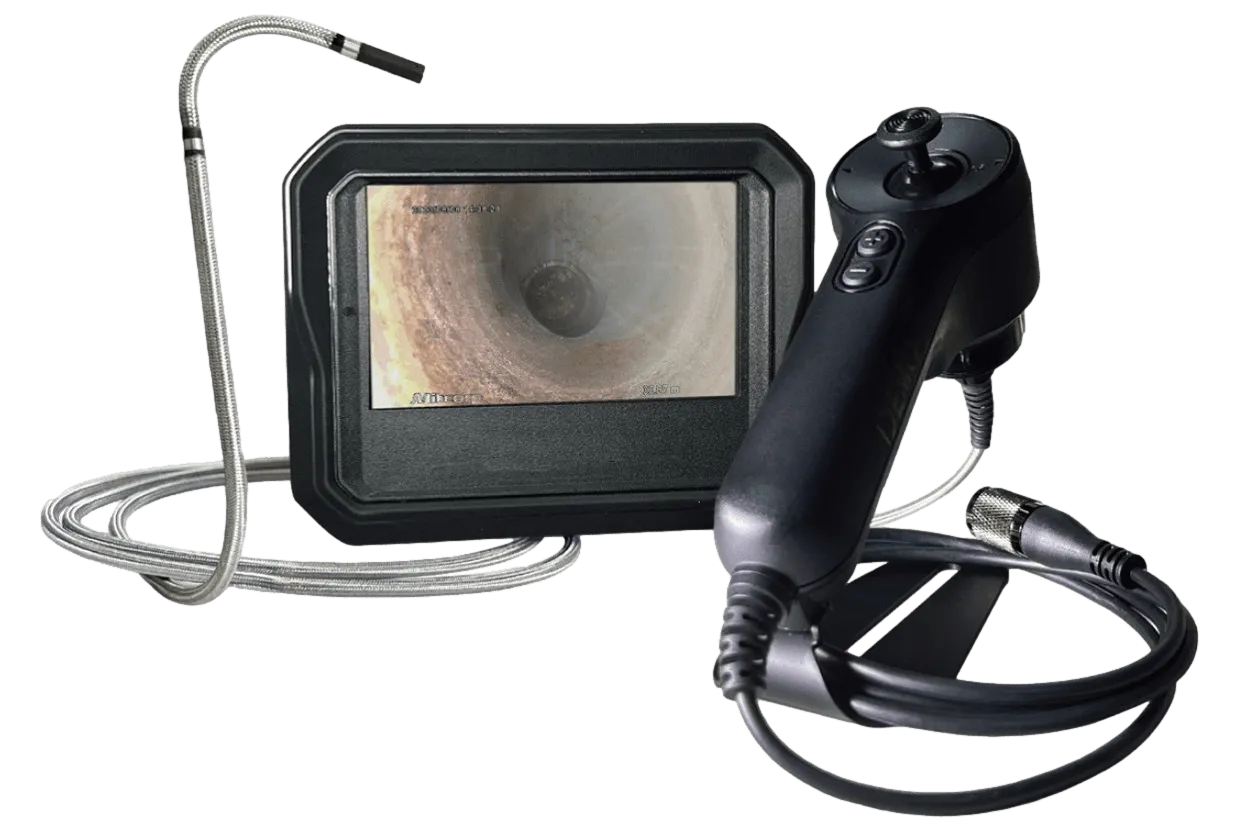
When you’re inspecting jet engines, access is everything. OEMs keep tightening clearances and shrinking access ports, yet maintenance teams are still expected to see more, document more, and make faster decisions. That’s where 4mm articulating borescopes come into their own. Slim, steerable probes let inspectors reach critical areas without partial teardown, saving time while improving inspection quality.
Compared with bulkier probes or non-articulating tools, a 4mm articulating borescope can navigate tighter ports, curve around blades and vanes, and give you clear views of surfaces that used to be difficult—or impossible—to assess in situ. For jet engine work, that combination of small diameter and precise steering is a genuine advantage, not a luxury.
Why 4mm is a sweet spot for jet engine access
Designed for modern engine access ports
Jet engines are full of carefully positioned borescope ports designed around specific diameters and bend capabilities. Too large, and the probe simply doesn’t fit or risks damaging the port; too small, and you sacrifice durability or image performance.
A 4mm probe typically hits the balance between:
- Small enough to pass through most common jet engine borescope ports
- Large enough to house quality optics, lighting, and articulation cables
- Robust enough to withstand repeated insertions in demanding environments
For many engine types, 4mm becomes a “universal” choice that can cover a broad portion of the fleet without needing a different scope for every model.
Reaching deeper without compromising safety
A slim probe diameter also helps reduce the risk of accidental contact. In tight gas paths, there’s less chance of scraping blades or liners while you maneuver, as long as technicians use proper insertion technique. That means fewer unintentional marks, less chance of introducing new issues, and more confidence during close-up inspections of sensitive surfaces.
The advantage of articulation in complex engine geometries
Seeing around corners and behind blades
In a jet engine, the most interesting surfaces are rarely the ones directly in front of the access port. Damage often hides:
- Behind the leading or trailing edges of blades
- Near blade roots or platforms
- Around internal lips, bosses, and cooling features
A 4mm articulating borescope allows the distal tip to bend inside the engine, so the camera can “look” sideways, backwards, or around curves. With 2-way or 4-way articulation, technicians can:
- Inspect multiple surfaces from a single port
- Follow suspected damage patterns along consecutive stages
- Revisit the same angle in future inspections for easy comparison
This isn’t just about convenience; it’s about reducing blind spots in areas where missed defects can have serious consequences.
Better defect characterisation
Articulation also helps you understand what you’re looking at. Viewing a suspected crack, nick, or pit from several angles makes it easier to distinguish:
- Superficial marks from true structural damage
- FOD impact from erosion or corrosion
- Minor wear from defects that justify engine removal
That richer visual context supports more accurate decisions, helping maintenance teams avoid both over-reaction (unnecessary removals) and under-reaction (missing early damage).
Operational benefits: time, cost, and availability

Reducing intrusive teardown is one of the biggest advantages of using a 4mm articulating videoscope. When an issue is reported—high EGT, vibration, unusual sounds, or chip detection—maintenance teams can quickly perform an in-situ inspection through OEM-designed access ports. This minimizes labour hours, preserves engine availability, and accelerates troubleshooting.
With the right borescope, technicians can:
- Inspect compressor and turbine stages without removal
- Verify suspected FOD impact
- Confirm erosion, burning, or coating degradation
- Capture high-resolution images for engineering review
Across a fleet, these savings translate into more predictable maintenance intervals and reduced operational disruption.
Across a fleet, those time savings add up to fewer disruptions and more predictable maintenance windows for aviation and other inspection-heavy industries.
Supporting on-condition decisions
High-quality borescope data helps engineering and reliability teams move toward more on-condition decisions. Instead of defaulting to conservative time-based removals, they can:
- Track defect growth across multiple inspections
- Decide whether blending or local repair is acceptable
- Justify continued operation when damage is clearly within limits
That translates to better use of engine life while still staying fully aligned with OEM and regulatory requirements.
Practical considerations when choosing a 4mm articulating borescope
Matching probe length and articulation to your engines
Not all 4mm scopes are created equal. For jet engine inspections, it’s worth specifying:
- Probe lengths that reach all required stages and chambers
- 4-way articulation with intuitive joystick or knob control
- Sufficient bending range to view both upstream and downstream surfaces
You’ll also want to consider factors such as sensor resolution, light output, and compatibility with existing recording or documentation systems. A well-chosen scope should feel like it’s built for your engine mix—not like you’re constantly working around its limitations.
Support, repair, and lifecycle
Because borescopes work in demanding environments, even well-treated tools will eventually need evaluation or repair. Working with a provider that offers dedicated inspection equipment services makes it easier to:
- Restore damaged articulation or sheathing
- Maintain consistent image quality
- Extend the life of high-value systems
For operations where engine downtime is expensive, predictable service options matter nearly as much as the tool’s performance on day one.
Getting the most from 4mm articulating borescopes in your shop

Jet engine inspection demands tools built for extremely tight internal geometries. Unlike sewer or plumbing cameras—which use stiff, wide-diameter push rods—aviation borescopes must be:
- Slim enough (around 4mm) for standard engine ports
- Highly flexible to navigate complex internal curves
- Fully articulating to inspect blade roots, trailing edges, and cooling features
- Lightweight and precise to avoid accidental contact with critical surfaces
These characteristics are essential for safe and effective turbine and compressor inspections. Larger industrial cameras simply cannot access these areas and are not designed for the aerodynamic sensitivities inside modern jet engines.
USA Borescopes focuses specifically on remote visual inspection equipment and understands the everyday realities of working around jet engines and other critical machinery. Their experience helping aviation and industrial teams match probe size, articulation and feature sets to real-world applications is reflected in their background and customer focus, outlined on their About Us page.
If you’re considering upgrading to 4mm articulating borescopes, standardizing your inspection tools across engine types, or simply want to understand what’s possible with modern jet engine inspection systems, it’s worth talking to a specialist. To review your current setup, explore suitable options and get tailored advice for your maintenance operation, contact USA Borescopes and speak with their team.
About the Author
This guest article was written by a technical content writer specialising in aviation maintenance and inspection technology. They work with equipment suppliers and MRO teams to translate hands-on experience with borescopes and videoscopes into clear, practical guidance that helps technicians, engineers and managers make better inspection and tooling decisions.